
You’re standing in front of a wall of decks, trucks and wheels, and every part comes with its own numbers and jargon. This guide to skateboard parts explained breaks the board down piece by piece, so you know what each part does, why it matters and when it’s worth spending money on.
What Are the Main Parts of a Skateboard and How Do They Fit Together?
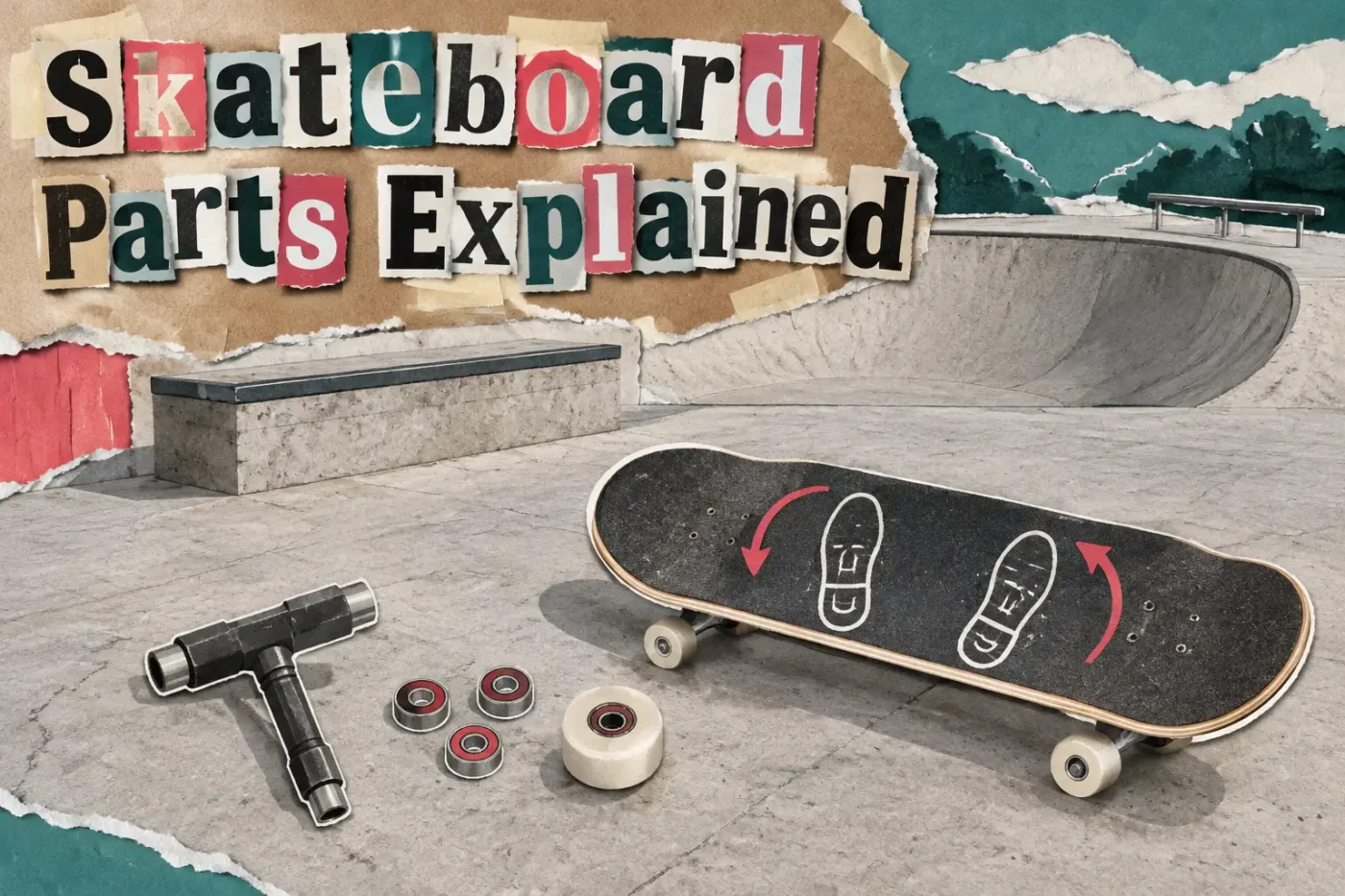
A skateboard has five core parts: the deck, grip tape, two trucks, four wheels and eight bearings. Hardware (bolts and nuts) holds the trucks to the deck, and small spacers sit between the bearings inside each wheel. Read the board from top to bottom and you get a stack: grip tape, deck, hardware, trucks, wheels, bearings. Each layer passes your weight and movement down to the next one.
The Complete Setup at a Glance
Your feet touch the grip tape, which is glued to the top of the deck. Two trucks bolt to the underside, and each truck carries two wheels on its axle. Inside every wheel, a pair of bearings lets it spin around that axle. That is the whole board, and you can buy every piece separately.
Why Every Part Affects How the Board Feels
The parts work as a system, so changing one changes how the others behave. A wider deck on narrow trucks feels awkward, and soft wheels on a smooth park feel slow and sticky. Loose trucks on a fast, downhill-style ride can feel twitchy. When a board feels wrong, the cause is usually a mismatch between two parts, not one bad part.
How Do the Deck, Shape, and Grip Tape Shape Your Ride?
The deck is the part you stand on, and it sets the first impression of the whole board. A standard deck is a laminated stack of thin wood plies, commonly seven-ply maple, pressed into a curved shape. The top and bottom are different: grip tape covers the top, while the underside carries the graphic. Three things on the deck decide how it rides: size, shape and surface.
Deck Width, Length, and Wheelbase
Width is the number most people look at first. Narrower decks feel quick and light, which suits flip tricks and technical street skating. Wider decks give your feet more room and feel steadier, which suits ramps, bowls and cruising. Wheelbase is the distance between the inner truck holes. A shorter wheelbase turns and flips more easily, and a longer one feels calmer at speed. If you are unsure, pick a middle width and let your own preferences guide the next deck.
Concave, Nose, and Tail
Concave is the side-to-side dip across the deck. Deeper concave locks your feet in and helps with flip tricks, and mellow concave feels more relaxed under your feet. The nose (front) and tail (back) are the upturned ends that let you pop the board off the ground. A symmetrical deck has matching ends, and some decks have a longer nose or a stiffer tail for different styles.
Grip Tape and Why It Matters
Grip tape is a sheet of sandpaper-like material stuck to the top. It keeps your shoes from sliding off and gives you the traction to pop, turn and land. It wears down with use, and once it smooths over or peels at the edges, your footing gets unreliable. It is the cheapest part to replace and the easiest to put off.
What Do Trucks Do and How Do You Choose the Right Size?
Trucks are the metal parts that connect the wheels to the deck, and they are what make a skateboard steer. You lean, the deck tilts, and the trucks pivot to turn the board. Choosing them comes down to their parts, how stiff they feel, and how well their width matches your deck.
Hanger, Axle, Baseplate, and Kingpin
Each truck has three main components: the hanger, the baseplate and the kingpin. The hanger is the T-shaped piece that holds the axle, and the wheels spin on the axle ends. The baseplate bolts to the deck. The kingpin is the large bolt that joins the hanger to the baseplate, with bushings and a pivot cup in between. That pivot cup is a small socket that lets the hanger rock side to side.
Bushings and How Loose or Tight Trucks Change Turning
Trucks and bushings are not the same thing: the truck is the whole metal assembly, and bushings are the small rubber cushions inside it. Bushing firmness controls how easily the board leans into a turn, and the kingpin nut sets how loose or tight that feels. Loose trucks turn sharply and feel good for carving and cruising. Tight trucks feel steadier at speed and when landing tricks. Start in the middle and adjust a little at a time, since a quarter turn of the nut is noticeable.
Matching Truck Width to Your Deck
The axle should line up roughly with the edges of the deck. If the axle sticks out far past the deck, the board feels unwieldy, and if the deck overhangs a lot, the wheels sit too far in. Check the deck width first, then pick trucks whose axle width is close to it. Buying a deck and trucks together, with their sizes labeled, removes most of the guesswork.
How Do Wheels and Bearings Change Speed, Grip, and Comfort?
Wheels and bearings are what actually touch the ground, so they change the ride more than their small size suggests. Wheels decide how the board handles surfaces, and bearings decide how freely it rolls.
Wheel Diameter and Hardness Explained
Wheel hardness is rated on the durometer scale with an “A” suffix. Softer wheels grip rougher ground and absorb vibration, which makes them comfortable for cruising and bumpy pavement. Harder wheels slide more easily and suit smooth parks and street tricks. Diameter works alongside hardness: smaller wheels are lighter and accelerate quickly, and larger wheels roll over cracks better and hold speed longer, though they add a little weight.
Bearings, Spacers, and Smooth Rolling
Bearings sit inside each wheel, two per wheel, and carry an ABEC rating. That rating matters less than most people think, because a clean, lightly lubricated bearing does more for ride quality than a higher number. The small spacers between the two bearings in a wheel help keep it spinning true and stop the bearings from being squeezed when you tighten the axle nut. Dirty or dry bearings sound gritty and slow the board down.
Which Hardware, Risers, and Small Components Should Beginners Know About?
The small parts get ignored until something goes wrong. They are inexpensive and they decide whether the rest of the board stays together and rolls cleanly.
Bolts, Nuts, and Correct Assembly
Eight bolts and eight nuts attach the trucks to the deck. Insert the bolts from the top so the heads sit flush in the grip tape, then add the nuts underneath and tighten them in a crisscross order, like tightening a car wheel. Tighten evenly so the baseplate sits flat. Bolt length matters: if you add risers, you need longer bolts to go through them.
Risers and Pads for Preventing Wheel Bite
Risers are flat spacers, usually plastic or rubber, that sit between the baseplate and the deck. They lift the trucks slightly so larger wheels can spin without rubbing the underside of the deck, a problem called wheel bite. Soft pads work similarly in a thinner form and also take a little vibration out of the ride. If your wheels are small relative to your trucks, you probably don’t need either, but if you move to bigger, softer wheels, they become the first fix to try.
Simple Maintenance Habits to Keep Parts Working Well
Check that the bolts and the axle nuts are snug every few sessions, since vibration loosens them over time. Wipe dirt off the bearings and add a drop of light lubricant when they start to sound rough or spin slowly. Rotate the wheels now and then so they wear evenly, and replace them once they are worn flat or thin. Watch the grip tape and the deck as well: peeling tape, a cracked nose or tail, or a deck that has gone soft and lost its pop all mean it is time for a new one.
Related guides
- Longboarding for Beginners: Choose a Board, Gear Up and Ride
- Skateboarding for Beginners: Gear, Balance, Stops and Ollies
Frequently Asked Questions
What are the main parts of a skateboard?
The main parts are the deck, the grip tape, two trucks, four wheels and eight bearings, held together with bolts and nuts. Trucks also contain bushings and a pivot cup, and the bearings use small spacers inside each wheel. Together these make up a complete board.
How wide should my skateboard deck be?
It depends mostly on your shoe size, your riding style and what feels comfortable. Narrower decks feel quick and suit technical street skating, while wider decks feel steadier for ramps, bowls and cruising. A middle width is a safe starting point, and you can move wider or narrower once you know what you prefer.
How do I know when to replace skateboard wheels, bearings or grip tape?
Replace wheels when they are worn flat, lopsided or too small to clear the deck without wheel bite. Replace bearings if cleaning and a drop of lubricant don’t bring back a smooth, quiet spin. Replace grip tape once it feels smooth under your shoes or lifts at the edges.
What is the difference between skateboard trucks and bushings?
Trucks are the full metal assembly that mounts to the deck and carries the wheels. Bushings are the small rubber cushions inside the truck, and they control how easily the board leans and turns. You can swap bushings without buying new trucks, which makes them a cheap way to change how the board steers.
Conclusion
A skateboard is a stack of parts that each force a decision: deck width, truck width, wheel hardness and bushing firmness all need to match how and where you ride. Grip tape, bearings and wheels wear out first, so they are the parts you will replace most often, while the deck and trucks are usually worth upgrading once you know what you want from your setup.
Start with a balanced setup, change one part at a time, and notice how the board responds after each change.