
Your board used to glide down the block with barely a push, and now it grumbles, drags and stops dead the moment you stop pushing. Before you blame your wheels or spend money on a whole new setup, look at the eight tiny steel rings spinning inside them. This guide explains how skateboard bearings work, how to pick a set that suits your riding, and how to install and look after them.
What skateboard bearings are and what they do for your ride
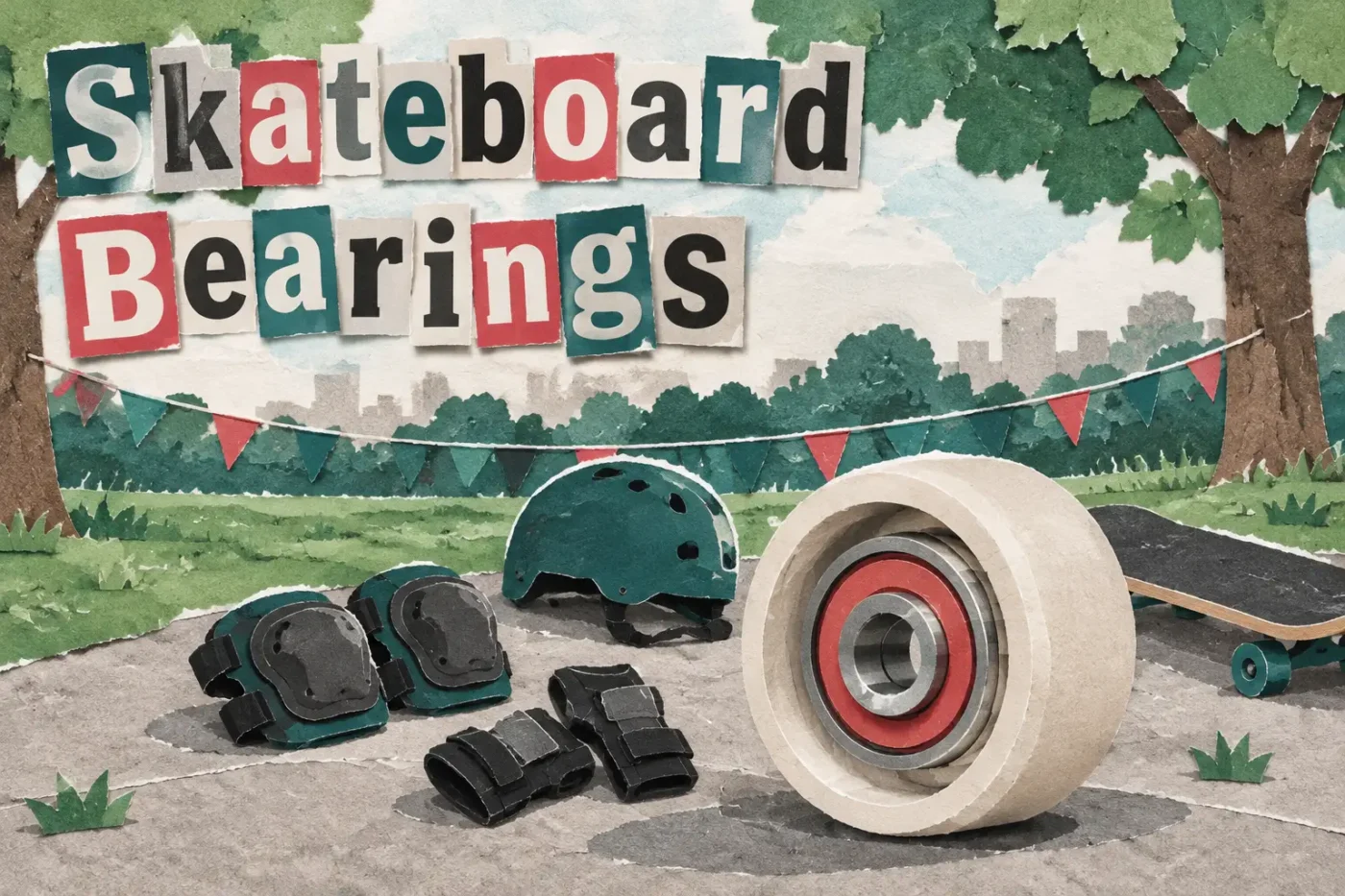
Skateboard bearings are small metal rings that let each wheel spin freely around the axle. Without them, the wheel would grind directly against the metal, and the board would barely roll at all. Standard skateboard bearings use the 608 size, which fits nearly every skateboard wheel and axle, so compatibility is rarely the problem when you shop for a replacement set. A full set is eight bearings, two per wheel.
The basic parts inside a bearing
Open up a bearing and you will find an outer ring, an inner ring, a row of small steel balls between them, and a retainer that keeps the balls evenly spaced. A shield on one or both sides keeps most dirt out and grease in. Each pair sits in the wheel with a spacer between them, and a speed ring or washer goes on the outside of the axle. Those extras matter, because they keep the bearings lined up and stop them from being squeezed by the axle nut.
Why bearings affect speed and smoothness
The balls roll instead of slide, so friction stays low and your push carries further. When the balls and rings are clean, well lubricated and seated straight, the wheel spins long and quiet. When grit gets in or the grease dries out, the balls start to drag, and you feel it as noise, slow rolling and a board that dies quickly on flat ground. A board that feels dead often has dirty or dry bearings.
Understanding bearing ratings and common terms
Bearing packaging is full of numbers and labels, and most of them sound more important than they are. A few terms are worth knowing so you can read a package without getting talked into the wrong set. Once you know what each label actually measures, shopping gets a lot simpler.
What the ABEC scale does and does not tell you
ABEC ratings, such as ABEC 1, 3, 5, 7 and 9, describe manufacturing tolerances. In plain terms, they say how precisely the parts were machined. They do not measure how well a bearing handles skate impacts, landings or sideways loads, so a higher number does not automatically mean a better skate bearing. Think of it as one small piece of information, not a quality ranking. Pay more attention to build quality, shield type and how the bearing feels when you spin it by hand.
Steel, ceramic, and other material differences
Steel is the standard material, and it is tough, easy to find and handles regular skating well. Ceramic bearings use ceramic balls instead of steel, which are harder and smoother and can stay cooler at speed. They also tend to resist rust better, though they still need proper care and cost noticeably more. For most riders, a decent steel set that you maintain will roll just as well day to day. Ceramic mostly appeals to people chasing a very smooth, quiet roll for cruising and distance.
Shields are the other label to check. Most skate bearings ship with removable rubber shields or non-removable metal shields. Removable rubber shields pop off with a pin or blade, so cleaning and re-lubricating is easy. Metal shields are sealed in, which makes deep cleaning harder, so those sets are often replaced instead of serviced.
How to choose bearings for your riding style
The right set depends less on spec-sheet numbers and more on what you do with your board. Ask yourself three things: how hard you land, how far you ride, and whether you plan to clean and service the bearings yourself. Your answers point to a clear choice.
Bearings for beginners and street skating
If you are learning or skating street and parks, durability matters more than top speed. Pick a solid steel set with shields you can remove, so you can clean them after wet sessions or dusty spots. Hard landings and grinding put a lot of stress on bearings, and cheap, simple sets are easy to swap when they wear out. Do not pay extra just for a high ABEC number, since impacts, not tolerances, are what wear skate bearings down.
Bearings for cruising and longboarding
Cruisers and longboarders push for long stretches and notice small differences in roll and noise. Here a smooth, quiet set with good lubrication is worth the effort, and ceramic is a reasonable upgrade if you want one. Look for bearings you can service, because commuting through dirt, grit and wet patches will clog them sooner than park skating does. Check that your wheels are not rubbing the truck or nut, since that mimics a bad bearing and wastes your push.
How to install and remove bearings step by step
Swapping bearings is a ten-minute job once you have done it once. Work on one wheel at a time so you do not mix up spacers and speed rings. Take it slowly, because forcing a bearing in crooked is the main way people damage them.
Tools you need before you start
A skate tool, or a socket wrench that fits your axle nuts, removes the wheels from the trucks. To pop old bearings out, you can use the end of the axle, a bearing puller tool, or a slim rod and a gentle lever. Keep your spacers and speed rings in a small tray so nothing rolls away. Grab a clean cloth too, so you can wipe the bearing seats before pressing new ones in.
Seating bearings evenly in the wheel
Follow these steps for each wheel:
- Take the wheel off the truck and pull both old bearings out of the hub.
- Drop a spacer into the wheel so it sits between the two bearings.
- Press the first new bearing onto the axle, push the wheel down onto it until it sits flat, then repeat from the other side.
- Refit the wheel with a speed ring on each side.
- Tighten the axle nut until the wheel stops wobbling but still spins freely.
Press straight down, never at an angle, and never push on the shield or the inner ring unevenly. If the wheel feels tight or gritty after tightening, loosen the nut a little and check again.
How to clean, lubricate, and maintain your bearings
A little regular care keeps a set rolling far longer than a quick swap. The idea is simple: remove the dirt, let them dry, add a small amount of the right lubricant, and put them back. Doing it yourself keeps the set smooth and quiet without constantly buying new parts.
To clean a set with removable shields, pop the shields off, soak the bearings in a suitable cleaning solvent and swirl them gently until the old grease and grit loosen. Let them dry fully, then add a few drops of skate-specific lubricant and spin them by hand to spread it. Fit the shields back on, and the bearings are ready to use again. Avoid heavy grease for speed-focused riding, since thick lubricant can slow the balls down.
Signs that your bearings need attention
The clearest sign is sound and feel. If a wheel grinds, rattles or squeals when you spin it, or it stops after only a few turns while the others keep going, that bearing is dirty or dry. A wheel that wobbles side to side on the axle, or catches at one spot in each turn, usually points to a damaged bearing, and it is better to replace it than to keep riding on it. Rust spots, a flat or dull roll on smooth ground, and a board that needs more pushing than it used to are all good reasons to stop and check the set. Try this quick test: spin each wheel by hand and compare them, and swap out any that sound or feel noticeably worse than the rest.
Common mistakes that wear bearings out faster
Water is the biggest enemy. Riding through puddles or leaving the board in a damp spot lets moisture in, and rust can start quickly if the bearings are not dried and re-lubricated. Overtightening the axle nut squeezes the bearings and makes them drag, while a nut left too loose lets the wheel wobble and chew up the seats. Skipping the spacers and speed rings is another common one, because bearings then get pinched or sit crooked. Finally, using the wrong lubricant, such as thick grease for speed or a general household oil that gums up with dirt, leaves the set rougher than when you started.
Conclusion
Skateboard bearings are small, but they decide how your board rolls, sounds and lasts. The 608 size fits almost every board, ABEC numbers only describe manufacturing precision, and the shield type tells you how easy the set is to clean. Pick bearings to match how you ride, seat them straight, and give them a regular clean and light lube, and a worn-out board often turns out to be a board that just needed fresh, well-kept bearings.